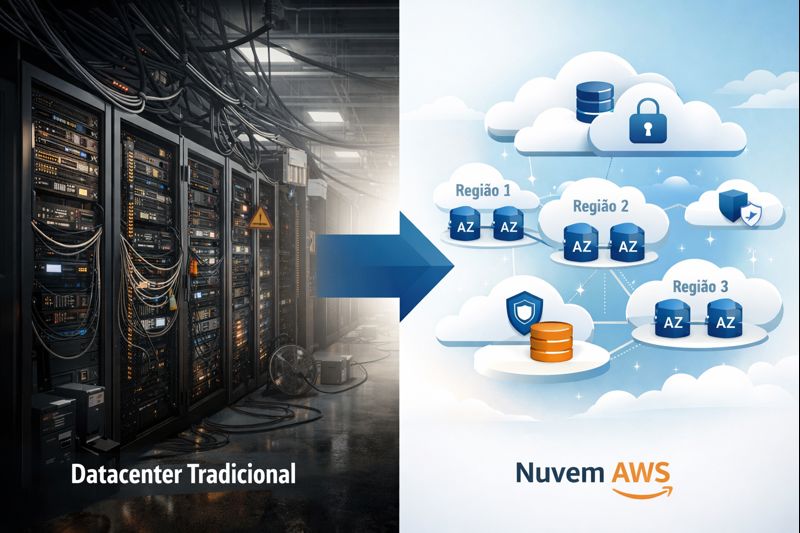
For decades, physical data centers were the heart of companies' IT operations. They stored critical data, ran applications, and ensured business continuity.
But they also required high investments, high energy consumption, constant maintenance, operational risks, and a single point of failure.
With the evolution of technology, this model is being replaced by a much more resilient, secure, and efficient paradigm: cloud computing — especially when we talk about the AWS (Amazon Web Services) cloud , the largest and most mature cloud platform in the world.
This transformation has a direct impact on productivity, team routines, and the speed of innovation in companies.
Today, documents, systems, and data that previously depended on a local infrastructure are now available from anywhere, with high performance, real-time collaboration, and levels of security virtually impossible to replicate in a traditional data center.
Naturally, this migration still generates doubts and fears.
A physical data center is, by definition, a single point of failure.
AWS operates a global architecture based on:
- Regions (independent geographic locations)
- Availability Zones (AZs) within each region
— physically separate data centers with independent power, network, and cooling systems.
This allows applications to be automatically distributed across multiple zones, ensuring:
- Service continuity even with the failure of an entire data center.
- Native high availability
- Tolerance for real-life disasters (fire, blackout, natural disaster, infrastructure failure)
This level of resilience simply doesn't exist in the traditional model.
2. Extremely secure database: RDS with Point-in-Time Recovery and Immutable Backup
When it comes to critical data, AWS raises the bar.
With services like Amazon RDS , your company gains access to:
🔹 Automatic and continuous backups
Without relying on manual processes or fragile routines.
🔹 Point-in-Time Recovery (PITR)
Ability to restore the database to any specific second in the past , allowing for precise recovery in case of human error, data corruption, or logical attack.
🔹 Immutable backups
Even if someone deletes data, credentials, or attempts an insider attack, backups remain protected and cannot be altered.
🔹 Automatic replication between zones
Your bank continues to operate even if an entire data center fails.
This transforms the database into a virtually indestructible asset.
3. Privacy, compliance, and access control
AWS operates under the strictest global security and compliance standards.
- LGPD, ISO, SOC, PCI-DSS, HIPAA, among many others.
- Encryption in transit and at rest by default.
- Identity management with fine-grained access control (IAM)
The company gains complete visibility into who accesses what, when, and from where , with full audit capabilities.
To be more and get to know our cloud services, have in your company the security and practicality of access to data you are looking for. Backup simply and safely! Contact us.
4. End-to-end encryption and protection
All data can be encrypted automatically:
- During the broadcast
- When stored
- In backups
Furthermore, keys can be managed by the company itself, guaranteeing complete sovereignty over its information.
Conclusion
While a physical data center tries to "protect itself,"
AWS was designed from the ground up to to be secure, resilient, and highly available by default.
Your company stops managing risks and starts operating on a global, distributed, automated infrastructure that is virtually immune to common failures.
Do you want to operate with this level of security?
Flexa helps your company migrate, architect, and operate in the AWS cloud with:
- Safety by design
- Enterprise-level backup and disaster recovery
- High multi-region availability
- Governance and cost control
Get in touch and discover how to transform your infrastructure into a growth platform, not a risk center.