Technological resources are no longer a luxury. Many people already use the internet, computers and tablets daily, all of which are interesting entry points for companies. And many of these features are among the most used technologies in business.
If applied correctly, they can provide multiple advantages for a company. There are several technologies that are in full use by various entrepreneurs around the world. As these features have already proven their effects, it is safer to apply them within your company. Just understand what structure is needed and what benefits are most interesting for your business.
To clarify the matter further, we have brought here a list of eight of the most used technologies in companies in recent years. Follow:
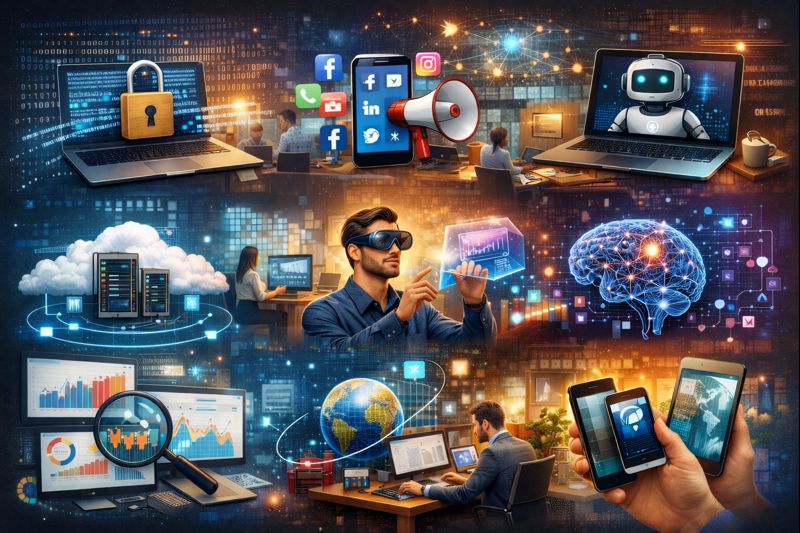
1. ENCRYPTION SYSTEMS
An encryption is a kind of text converter code. A given file or program has its source code transformed based on a pattern. For example, changing all letters to numbers. Unless the reader has the same conversion key or knows the standard used, he will not be able to access the encrypted information.
Nowadays, having one or more encryption systems within your company is practically mandatory. Depending on the complexity of the code used, it's possible to guarantee that no information can be accessed, even if the data has been captured in a breach. Many technology service providers, especially cloud storage, offer their own encryption to ensure the security of their clients.
2. SOCIAL MEDIA
Despite being one of the most used technologies by many people, social networks only became a fundamental tool in companies recently. We are not only referring to the most well-known social networks, but also to the concept of social media.
In addition to being present on networks like Facebook and LinkedIn, you can also use the same principles of social media in your company. An example is creating a company-specific application where you can communicate with your customers directly, answering questions and dialoguing.
3. BOTS
Also called “robots”, they were already very present in the business world during 2016, but they continue as a trend this year. Basically, they are systems that simulate certain human actions based on pre-programmed patterns. Their main use is as text-attendant assistants, but they can also help with simulations of audience behavior.
With proper programming, it is possible to leave a bot in charge of several basic functions of attendance and interaction with the public, without running the risk of falling into the trap of creating an answering machine, which would cause some aversion at the time of contact.
4. CLOUD COMPUTING
Among the most used technologies within companies, the storage of information in the cloud is probably the most prominent. But cloud computing goes a little beyond this functionality: it includes remote access to company systems, use of outsourced resources on demand, paying only for what is consumed.
Cloud computing systems have allowed small businesses to develop much faster, as it is no longer necessary to have their own structure to access certain features. In addition, many companies that relied on one location can now become flexible, which facilitates the expansion of certain systems and processes.
5. AUGMENTED REALITY
You've probably heard of how successful the Pokemon GO game was. Despite being simple, the technological structure used to keep the game running is revolutionary. And, in fact, it is already in use by many companies around the world. By applying it on a smaller scale, you won't have to bear the same cost level.
Augmented reality (bringing virtual things into the real environment) is still a semi-experimental practice. But as it is growing, it may be among the most used technologies in the world in a short time. If you intend to stay ahead of the competition and can benefit from the interactivity between the virtual and real world, it might be a good idea to start investing here.
6. MACHINE LEARNING
The ability of machines to acquire new knowledge has always been questioned. However, even if a bot cannot intuitively associate information, it can follow patterns and compare data over time. This allows it to improve and make certain decisions based on current trends.
Giving a machine the ability to adapt to certain situations considerably reduces the adjustment time that would be required to maintain its proper service to the public.
7. BIG DATA
One of the most recurrent concepts within companies and also one of the most useful. Accumulating information from multiple sources and being able to analyze it together is critical to making good business decisions. Especially in big business. Considering that the speed at which data emerges is increasing, no one person can keep up with this alone.
The trend is that, in a short time, big data will evolve even more. It is already one of the most used technologies in large companies due to the processing of relevant information. It is estimated that soon it should be able to generate business actions practically in real time.
8. MOBILE ACCESS
Considering that most information nowadays can be integrated through cloud computing, many companies are already applying these features to mobile browsing. For example: instead of having to access the company's server from a desktop, it is possible to do so from a tablet or even a smartphone.
The immediate consequence here is greater flexibility and accessibility. With the possibility of viewing any information on the cell phone, it is possible to make business trips, serve clients anywhere, among other possibilities. And currently this is not such a high investment, in addition to enabling a much broader return.
Now that you know some of the most used technologies in companies, you can choose which ones fit your needs.
Do you think this post can be useful for other companies and people? So share on your social media and show how technology can leverage a business.