Migrating to AWS is no longer just a technological decision—it's become a financial efficiency strategy . Companies operating with legacy infrastructure or poorly configured cloud environments face unpredictable costs, low scalability, and constant waste. The good news is that, with the right planning , migrating to AWS can reduce expenses by up to 70% , without compromising performance or security.
In this article, you'll understand how migrating to AWS works from start to finish and why it's one of the smartest moves for companies seeking operational efficiency.
Why does migrating to AWS reduce costs?
AWS offers an on-demand consumption model, where your company pays only for what it uses. This eliminates high investments in hardware, licenses, and data center maintenance.
Furthermore, the cloud allows:
- Adjust resources according to actual demand.
- Replacing idle infrastructure with elastic services
- Apply continuous cost optimization policies.
- Gaining financial predictability through proper governance.
When executed well, migration is not just technical—it's financial and strategic.
Step-by-step migration to AWS
An efficient project follows well-defined steps, reducing risks and maximizing results:
- Assessment of the current environment
Mapping of existing servers, applications, dependencies, and costs.
- Planning and architecture
Defining the best cloud model, suitable AWS services, and security strategy.
- Preparing the environment (Landing Zone)
Creating a secure, scalable, and governable foundation for cloud operations.
- Workload migration
Gradual implementation, with testing, validation, and minimal business disruption.
- Optimization and FinOps
Post-migration adjustments to ensure efficient use of resources and continuous cost reduction.
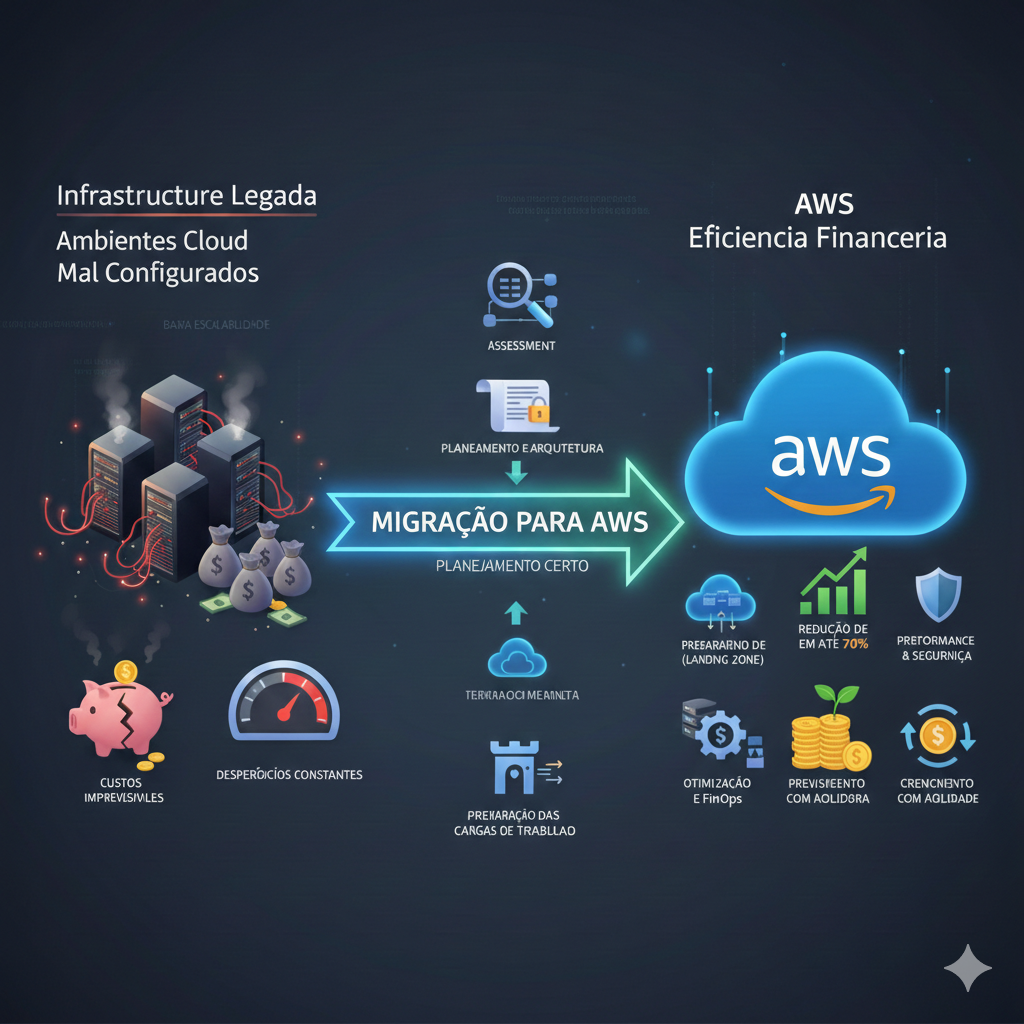
Continuous optimization: where the economy really happens.
Many companies believe that cost savings only occur during migration, but the greatest gains lie in the ongoing management of the AWS environment . With FinOps practices and constant monitoring, it's possible to identify waste, resize resources, and keep costs under control over time.
This process ensures not only cost savings, but also performance, security, and scalability aligned with business growth.
Conclusion
Migrating to AWS, when well-planned and executed, transforms infrastructure into a strategic asset. More than just reducing costs, it prepares your company for agile growth, innovation, and financial predictability.
If you want to understand how to apply this process safely and efficiently, talk to Flexa Cloud and discover how to optimize your journey to the cloud.